
Rules of the road
At Bike at Illinois, we want to make sure you have a safe ride every time. The university promotes safe and responsible bicycling behavior by enforcing state and local traffic laws for everyone, including bicyclists. Bicycle traffic enforcement is not meant to discourage people from riding bikes, but to encourage them to ride in a safe, predictable way for everyone’s safety and benefit.
Rule 1: Follow Campus Rules
Did you know there is a University Bicycle Ordinance all individuals on campus must follow? The Ordinance is a policy within Campus Administrative Manual (CAM) and is intended to be enforced to promote education, awareness, and safety for all on campus. It includes information on definitions, bicycle registration, bicycle parking, operations, and diversion programs.
| University Sidewalks | Bike Lanes and Bike Paths | Shared-Use Paths | Quad Areas* | Roadways | |
| Traditional Bicycles | Yes | Yes | Yes | Yes (8 mph) | Yes |
| Class – 1 E-Bikes | Yes (8 mph) | Yes | Yes | No | Yes |
| Class – 2 E-Bikes | No | Yes | No | No | Yes |
| Class – 3 E-Bikes | No | Yes | No | No | Yes |
| Low-Speed E-Scooters & Micromobility Devices | Yes (8 mph) | Yes | Yes (8 mph) | No | Yes |
| E-Motos/OCEVs | No | No | No | No | Yes |
Traditional Bicycle
Every human-powered device and every low-speed electric bicycle with 2 or more wheels not less than 12 inches in diameter, operable pedals, and designated seats for the transportation of one or more persons, as defined by Illinois Senate Bill 2285.
Class-1 E-Bike
A bicycle equipped with fully operable pedals and an electric motor of less than 750 watts that provides assistance only when the rider is pedaling and that ceases to provide assistance when the bicycle reaches a speed of 20 miles per hour.
Class-2 E-Bike
A bicycle equipped with fully operable pedals and an electric motor of less than 750 watts that may be used exclusively to propel the bicycle and that is not capable of providing assistance when the bicycle reaches a speed of 20 miles per hour.
Class-3 E-Bike
A bicycle equipped with fully operable pedals and an electric motor of less than 750 watts that provides assistance only when the rider is pedaling and that ceases to provide assistance when the bicycle reaches a speed of 28 miles per hour.
Low-speed Electric Scooter or E-Scooter
A powered stand-up or sit down scooter using a small electric motor. A device weighing less than 100 pounds, with 2 or 3 wheels, handlebars, and a floorboard that can be stood upon while riding, that is solely powered by an electric motor and human power, and whose maximum speed, with or without human propulsion, is no more than 10 miles per hour, as is defined by Illinois Vehicle Code, 625 ILCS 5/1-140.11. “Low-speed electric scooter” does not include a moped or motor-driven cycle.
E-Motos/OCEVs
E-Motos or Out-of-Class Electric Vehicles. Any device resembling an electric bicycle that does not follow the definition of an electric bicycle, as defined above, is considered a motor vehicle and is not regulated by this Ordinance. (E.g. a bicycle-like device that is equipped with an electric motor of greater than 750 watts). These vehicles must be registered with the University Parking Department. They are not allowed to operate on bicycle infrastructure on campus.
University Sidewalks
An off-street unmarked pathway for the primary use of pedestrians.
Bike Lanes
An on-street lane marked for the use of bicycles using symbols or markings.
Bike Paths
An off-street pathway marked for exclusive use by bicycles using symbols or markings.
Shared-Use Paths
An off-street pathway for the shared-use of pedestrians, bicyclists, and other non-motorized transportation. Typically, pathways greater than 10 feet wide are considered Shared-Use Paths (Exceptions include – paths on all campus Quad areas)
Quad areas
This includes the areas of campus known as Main Quad, South Quad, Bardeen (or Engineering) Quad, Oval Allee, and Ikenberry Commons Quad.
Roadways
Any public road on which motor vehicles are permitted to travel.
Rule 2. ALWAYS RIDE SAFELY
These are the most important points to remember when riding a bike on campus.
- Bikes share the same rights and responsibilities as cars. You can get a citation for violating state, local, or university traffic laws on a bicycle.
- Always ride in the same direction with traffic. If you ride the wrong direction on a one-way street, you can get a moving violation on your driver’s license.
- Obey all traffic signals and signs, just like a motor vehicle. Same Roads, Same Rights, Same Rules.
- Yield to pedestrians on sidewalks and shared-use paths, and at all intersections. If pedestrian traffic is very heavy, walk your bicycle or move to the nearest street.
- Position yourself where cars can easily see you. Avoid sidewalks and do not weave in and out between parked cars.
- Signal your turns and lane changes. You can also signal when you are reducing speed. Signaling and Scanning
- Never try to squeeze between a bus or a truck on the right at intersections. Always use caution when passing on the right as buses and trucks, even in a bike lane, as they often pull over to the curb and they may not be able to see you.
- Alert pedestrians before passing, with a bell or by telling them which way you are going. They will appreciate the heads-up!
- Use lights and reflective clothing at night. Front and back lights or reflectors are the law for bikes, and bright visible clothes are best.
- Keep your bicycle in good working order, for your safety and the law.
- Parking is only allowed at designated bicycle parking areas. If parked outside the bicycle parking areas your bicycle lock may be cut and the bicycle removed by campus authorities. If you have locked your bicycle in a stairwell or to an accessibility ramp, your bicycle will be removed immediately.
Rule 3: Follow the Law
The State of Illinois Vehicle Code says bicyclists “shall be granted all of the rights and shall be subject to all of rules and laws applicable to the driver of a vehicle.” Bicyclists breaking motor vehicle laws can receive a state traffic citation under the Illinois Vehicle Code. Also, both Champaign and Urbana have municipal ordinances under which cyclists can receive traffic citations.
Rule 4: Keep Learning
Take a quick Bicycle Safety Quiz if you are new to Illinois traffic laws!
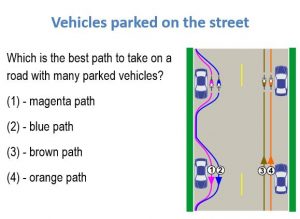
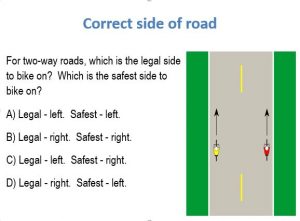
Examples from bikesafetyquiz.com
Online Traffic Skills 101 Course by League of American Bicyclists. Free, online course – check it out and say you’re from Champaign County.